Tuesday, July 14, 2015

Topic 39: House Clears 21st Century Cures Act – What could it mean for MA and CD?


As we have alluded to before, the House and Senate have been considering another tweaking of regulations related to pharma as part of the broad 21st Century Cures Act (Act).  The House has taken a big step forward by approving on a bi-partisan basis the Act.  Most of the headlines are focused on the increase in NIH funding, but for pharma people there is a lot of interesting suggested changes in the regulatory environment.  NOTE: this is just the House version, the Senate will not take up the bill to later this year so we don’t know if any of these changes will come to pass – so far at least the White House is not threatening a veto.

You can find the whole bill here.

Medical Affairs: All about off label communication

Act Requirement:

Subsection 2102 explicitly requires the regulatory clarification about acceptable dissemination of off-label information:
Not later than 18 months after the date of enactment of this Act, the Secretary of Health and Human Services shall issue draft guidance on facilitating the responsible dissemination of truthful and non-misleading scientific and medical information not included in the approved labeling of drugs and devices.

Implication for MA:

While conceivably once this guidance is issued anyone (commercial and medical) from the company can share off-label information, if the guidelines are anything like the guidance provided by the FDA in their response to the Amarin lawsuit which we discussed here that guidance will explicitly require that the information be discussed by someone from the company with “…  the appropriate background or training to accurately communicate scientific information.” 
So, conservatively interpreting that definition, if this act passes MA should finally have clear guidelines on how to proactively discuss off-label information.  A BIG win for MA.

Clinical Development and Medical Affairs: Support for innovation in clinical trials

Act Requirements:

There are a number of requirements that could be clarified by the Act.  I will highlight a few I think are most impactful.

The first is section 2021 which discusses the use of biomarkers.  It establishes a process whereby biomedical research consortia can identify and agree upon biomarkers, then submit those biomarkers to the FDA for their review and approval, and once approved can be used by industry as surrogate endpoint.  Draft guidance on this process is due no later than 24 months after enactment.

The second is subsection 2061, focused on broader use of adaptive trial design and Bayesian statistics. The Act requires the FDA to update and finalize the guidance on adaptive trial design within 18 months and issue draft guidance on the use of Bayesian statistical models within 48 months.  So not exactly pushing the envelope on the Bayesian timeline for draft guidance.

The next is subsection 2062 deals with the use of “real world” observational / registry / safety data in the application for additional indications or to meet post-approval requirements.  It requires that a program for the use of this type of data in these ways be established within 24 months including delineating when this type of data will be acceptable to the FDA, the standards and methods needed to be followed when collecting this data.  One year after the program is up and running draft guidance is due and then a year after that final guidance is due.

Implications for CD MA

The implications of the acceptance of biomarkers as acceptable surrogate endpoints should have huge implications.  Currently these endpoints are gathered but are not relied upon for fear that they will not be acceptable.  Knowing in advance that they will be acceptable to the FDA will allow for much more streamlined data collection efforts.

Further clarity on adaptive trial design will be helpful but not earth-shattering.  Adaptive trial design draft guidance already exists so all the act is really doing to pushing to get it out of the draft phase and finalized which should reduce risk and make adaptive trial designs more acceptable to less risk-tolerant organizations.  This will hopefully push into becoming a standard in P2 trials, reducing the need for multiple trials.  I’m not really qualified to discuss how the Bayesian statistical model impact development – if you understand this better than me please leave a note in the comments.

The “real world” data requirement, assuming it produces clear definitions from the FDA about the qualities that the data has to have to be acceptable, could be a dual edged sword.  On the one hand, if they have very high expectations about the quality and cleanliness of this data in some cases, especially registries, it could raise the costs.  On the other hand, clear definition of what data will be acceptable for additional indication applications will allow for the use of this data more broadly and thus more of these studies to be conducted, which is great overall for pharma.

I am curious to know what you think.  Please leave a comment here.


Friday, June 26, 2015

Topic 38 – FDA Comments on Off-label Dissemination – Did it just tip its hand on upcoming off-label policy?


Have you had the opportunity to follow the Amarin lawsuit against the FDA?  If not, a quick recap:  
Amarin is literally a fish-oil salesman – they have fish-oil pills that are already FDA approved for the treatment of very high levels of triglycerides.  They had conducted clinical trials to expand their label to patients with lower levels of high triglycerides.  The FDA rejected their application.  Amarin decided it wanted to share the results of those studies anyway since they were positive and sued the FDA for the right to share its data on off-label use.

The interesting part comes from the FDA response letter.  Putting aside their primary concern that Amarin failed to work with them before suing them, the letter signed by Janet Woodcock went on to layout the condition in which Amarin (or for that matter any pharam company) can share off-label data.

First, the letter reiterated what we already know and have discussed: the reprint exemption to off label communication – distribute reprints from peer-reviewed journals, avoid some simple issues like highlighting only the “good” passages, and you are in the clear.

But then the letter goes on to say that Amarin can also write up and distribute its own summary of the results of their trial if the write up:

  • Remains factual and does not omit material information or introduce bias
  • Includes full data for each treatment group
  • States that the current label does not approve of the use
  • States that the impact on the off-label use has not been determined
  • Shares data about other, known similar studies that may have different results
  • Any financial or affiliation biases between the firm and the people who conducted the study

They go on to add that to protect against being misleading the company should:

  • Provide a copy of the current Package Insert
  • Provide a copy of any relevant reprints
  • Discuss these topics in an educational or scientific setting and not as a part of a promotional discussion or attached to promotional materials
  • Discussions should be conducted by persons with the appropriate background or training to accurately communicate scientific information

While that is still a lot of hurdles, that is a long way from reprints only.  And while these are NOT an official policy now, I think this is telegraphing what we should expect to see in the upcoming policies.

I particularly like the final bullet point which makes it clear that these topics need to be discussed by roles that sound very much like MSLs. 

To speculate, if the FDA were to allow establish this as the policy, it would surely free up MA to proactively share both off label and label supportive information.  That would be a big improvement for some MA organizations that deny all proactive sharing of off-label information.

You can find the letter HERE.  The juicy bits begin on page 8.

What do you think?  Click here to leave a comment.

Monday, June 8, 2015

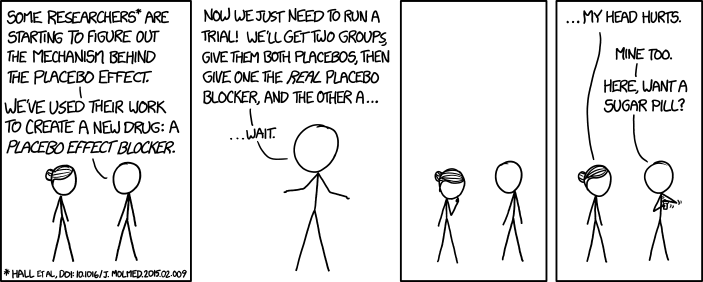
In Case You Missed It - Placebo Blocker

From the awesome xkcd.com - the Placebo Blocker


Original caption: They work even better if you take them with our experimental placebo booster, which I keep in the same bottle.

Wednesday, June 3, 2015

Topic 37: Medical Affairs and the Integrated Payer / Provider Model


For a while we have been discussing the need for a specialized medical affairs function focused on Payers – we discussed it here.

But what about Accountable Care Organizations (ACOs) or other integrated payer / provider models, where the provider owns both the cost and the outcomes of their work.  This type of model is becoming more and more prevalent, yet most MA organization have not flexed to directly engage with these types of organizations. 

The needs for these organization are not a match for current MSL field organizations focused on HCPs and, while payer oriented organizations may be better suited, they are not a perfect match either.

Like payers, these groups are interested in population-level information.  And, like payers, they care about total cost of care.  But like HCPs they also place a greater emphasis on understanding treatments in the context of the overall disease progression and methodologies for approaches for ensuring improved outcomes with existing treatments.
I suggest that MA organizations are going to need to develop groups that directly target these ACOs.  These will be teams that understand population health and quality metrics.
And MA is going to need to collect this population data directly.  

 One thing that seems clear is that HEOR secondary endpoints gathered during P3 simply lack credibility with these audiences since they know the P3 had inclusion/exclusion criteria that did not model their patient population.  Real world data and post marketing studies, already important for payers, is going to be equally important for these ACOs.

MA is going to need to come to them with models of costs and outcomes and budget impact, then partner with them to validate the model and gather relevant data about treatment approaches which produce the best results for the least costs.  

What do you think?  Leave a comment by clicking here.